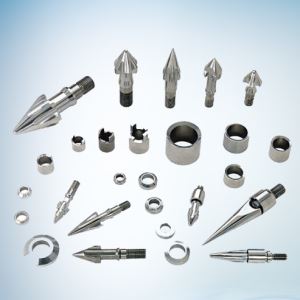
What are the components of single screw extruder?
Sep 06, 2021
In general, the most basic and common is single screw extruder. It mainly includes six parts: transmission, feeding device, feeding barrel, screw, head and mouth model.
I. Transmission part
The transmission part usually consists of motor, reduction gearbox and bearing. In the extrusion process, the screw speed must be stable and cannot change with the change of screw load, so as to keep the quality of the obtained products uniform and consistent. However, in different occasions, it is required that the screw can change speed to meet the requirement that a device can squeeze out different plastics or different products. Therefore, this part generally adopts AC rectifier motor, DC motor and other devices to achieve continuously variable speed. Generally, the screw speed is 10~100 r/min.
The function of the transmission system is to drive the screw and supply the torque and rotation speed required by the screw during extrusion, which is usually composed of motor, reducer, bearing, etc. On the premise that the structure is basically the same, the manufacturing cost of the reducer is roughly proportional to its external dimension and weight. Because the shape and weight of the reducer are large, it means that there are more materials consumed during manufacturing, and the bearings used are also relatively large, which increases the manufacturing cost.
For extruders with the same screw diameter, high-speed and efficient extruders consume more energy than conventional extruders. It is necessary to double the motor power and plus-sized the base number of reducer accordingly. But high screw speed means low reduction ratio. For reducers of the same size, compared with those of reduction ratio lower, the gear modulus increases and the reducer's load bearing capacity also increases. Therefore, the increase of the volume and weight of the reducer is not linearly proportional to the increase of the motor power. If the amount of extrusion is used as the denominator, divided by the weight of the reducer, the number of high-speed and efficient extruders is small, and the number of ordinary extruders is large. In terms of unit output, the motor power of high-speed high output extruder is small and the weight of reducer is small, which means that the manufacturing cost of high-speed high output extruder per unit output machine is lower than that of ordinary extruders.
II. Feeding device
Generally, granular materials are used for feeding, but ribbon materials or powder materials can also be used. The filling equipment usually uses conical feeding Hopper, and its volume is required to provide at least one hour of consumption. There is a cutting device at the bottom of the Hopper to adjust and cut off the material flow, and the side of the Hopper is equipped with a visual hole and a calibration metering device. Some hoppers may also have Pressure Relief Devices or heating devices to prevent raw materials from absorbing water from the air, or some hoppers may also have their own mixers, which can be automatically fed or fed.
1. Hopper
Hopper is generally made into symmetrical form. A window is opened on the side of the Hopper to observe the material level and feeding condition. There is an opening and closing door at the bottom of the Hopper to stop and adjust the feeding amount. Cover is added above the hopper to prevent dust, moisture and impurities from falling into it. When selecting Hopper materials, it is best to use lightweight and easy-to-process materials, and aluminum plates and stainless steel plates are generally used. The volume of the Hopper depends on the size of the extruder and the feeding method. Generally, the extrusion amount of the extruder is 1 to 1.5h.
2. Feeding
There are two feeding methods: manual feeding and automatic feeding. Automatic feeding mainly includes spring feeding, blast feeding, vacuum feeding, conveyor belt conveying feeding and other forms. In general, small extruders are manually fed, while large extruders are automatically fed.
3. Classification of feeding methods
① gravity feeding:
Principle-the material enters the barrel by its own weight, including manual feeding, spring feeding and blast feeding.
Features-simple structure and low cost. However, it is easy to cause uneven feeding, thus affecting the quality of the parts. It is only suitable for small size extruders.
② forced feeding:
Principle-install a device that can exert external pressure on the material in the hopper and force the material into the extruder barrel.
Features-it can overcome the phenomenon of "bridging" and make the feeding even. The feeding screw is driven by the extruder screw through the transmission chain to adapt its rotating speed to the rotating speed of the screw. The overload protection device can be started when the feeding port is blocked, thus avoiding the damage of the feeding device.
3. Barrel
Generally, it is a metal barrel made of alloy steel or composite steel pipe lined with alloy steel. Its basic features are high temperature and pressure resistance, strong wear resistance and corrosion resistance. Generally, the length of the barrel is 15~30 times of its diameter, and its length is based on the principle that the material is fully heated and plasticized evenly. The barrel should have enough thickness and rigidity. The interior should be smooth, but some cylinders are engraved with various grooves to increase the friction with plastic. A electric heater, temperature automatic control device and cooling system heated by resistance, inductance and other means are attached to the outside of the barrel.